
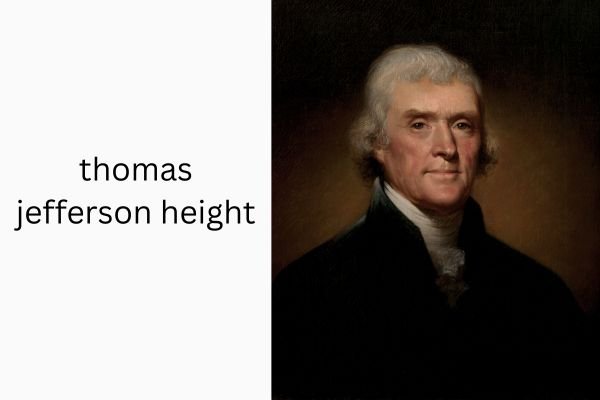
Thomas Jefferson Height
Thomas Jefferson height is 6 feet 2.5 inches (189 cm). This measurement comes directly from firsthand accounts by people who knew him personally, including his own grandson. At a time when the average American man stood around 5 feet 8 inches, Jefferson towered over nearly everyone in the room — a fact contemporaries frequently remarked upon.
QUICK FACTS TABLE
| Attribute | Detail |
|---|---|
| Full Name | Thomas Jefferson |
| Height | 6 ft 2.5 in (189 cm) |
| Build | Lean, slender, “no surplus flesh” |
| Date of Birth | April 13, 1743 |
| Died | July 4, 1826 (age 83) |
| Birthplace | Shadwell, Virginia, British America |
| Nationality | American |
| Zodiac Sign | Aries |
| Profession | Statesman, 3rd U.S. President, Author, Architect |
| Shoe Size | Not documented in historical records |
EARLY LIFE & BACKGROUND
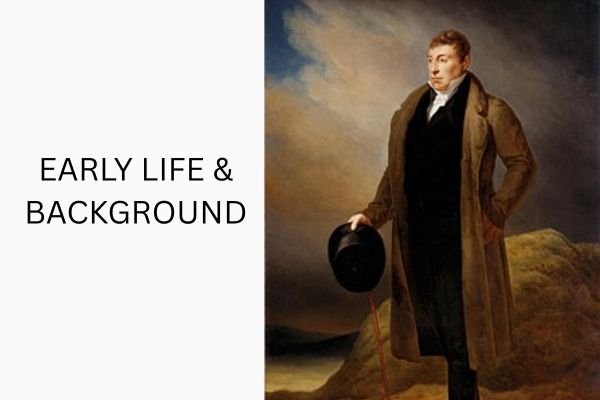
Thomas Jefferson was born on April 13, 1743, at Shadwell, his family’s plantation near present-day Charlottesville, Virginia. He was the third of ten children born to Peter Jefferson, a surveyor and planter, and Jane Randolph Jefferson, who came from one of Virginia’s most prominent families. Jefferson’s father died when Thomas was just 14, leaving him a substantial inheritance of land and enslaved people that shaped much of his later life and fortune.
A gifted and disciplined student, Jefferson began studying Latin, Greek, and French at age nine. He entered the College of William & Mary at 16, where he was mentored by professor William Small and studied law under George Wythe, one of colonial Virginia’s leading legal minds. Even as a young man, Jefferson stood out physically — already tall, lanky, and known among peers for his reddish hair, earning him the early nickname “Long Tom” well before he became a national figure. This combination of intellectual seriousness and a commanding physical presence would define much of how Jefferson was perceived throughout his public life.
CAREER JOURNEY / TIMELINE
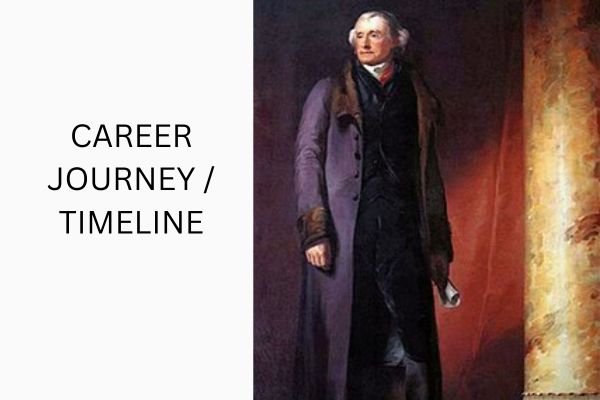
1767 — Admitted to the Bar: Jefferson began practicing law in Virginia, building a reputation as a meticulous and articulate legal mind.
1769 — Virginia House of Burgesses: He entered political life, representing Albemarle County and aligning himself with the growing colonial resistance to British rule.
1774 — “A Summary View of the Rights of British America”: Jefferson’s widely circulated pamphlet argued against Parliamentary authority over the colonies, establishing him as a leading revolutionary thinker.
1775-1776 — Continental Congress and the Declaration of Independence: Selected as a Virginia delegate to the Second Continental Congress, Jefferson was chosen to draft the Declaration of Independence at just 33 years old. The document’s opening lines remain among the most quoted in American history.
1779-1781 — Governor of Virginia: Jefferson led the state through a difficult period of the Revolutionary War, including a controversial British invasion that forced him to flee Monticello.
1785-1789 — Minister to France: Jefferson succeeded Benjamin Franklin as U.S. Minister to France, where he observed the early stirrings of the French Revolution and expanded his interests in architecture, wine, and science.
1790-1793 — First U.S. Secretary of State: Under President George Washington, Jefferson helped shape early American foreign policy while clashing repeatedly with Treasury Secretary Alexander Hamilton over the direction of the young republic.
1797-1801 — Vice President: Jefferson served under John Adams after finishing second in the 1796 election, a quirk of the electoral system at the time.
1801-1809 — President of the United States: As the third president, Jefferson’s two terms included the Louisiana Purchase in 1803, which doubled the size of the country, and the Lewis and Clark Expedition, which he personally commissioned.
1809-1826 — Retirement at Monticello: Jefferson spent his later years designing and refining his home at Monticello, founding the University of Virginia in 1819, and maintaining an extensive correspondence with figures like John Adams. He died on July 4, 1826 — exactly fifty years after the Declaration of Independence was adopted, and on the same day as Adams.
PHYSICAL APPEARANCE IN DETAIL
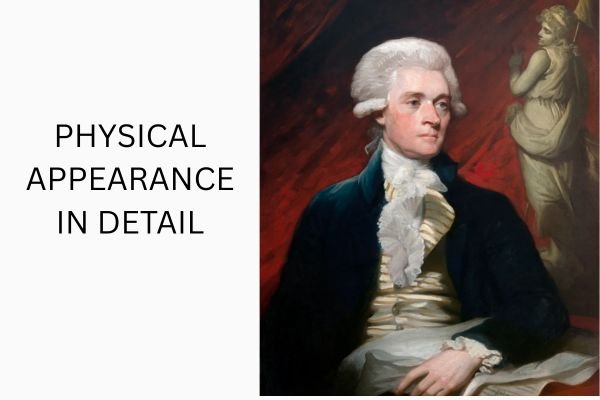
Contemporaries consistently described Jefferson as tall, lean, and loose-limbed. His grandson, Thomas Jefferson Randolph, put his height precisely at six feet two and a half inches, and this figure is echoed in the writings of others who spent time with him, including biographer Henry S. Randall. One visitor, George Ticknor, wrote that he had always imagined Jefferson to be a small man and was startled to find him “more than six feet high.”
Jefferson had reddish-blond hair in his youth that lightened with age, along with hazel or gray-blue eyes depending on the account. His build was notably thin and angular rather than muscular — one Monticello overseer compared him to “a fine horse” with “no surplus flesh.” He had a freckled, ruddy complexion and stood with an easy, unassuming posture that some found at odds with his height and status. Rather than adopting the powdered wigs and formal court dress favored by many of his era’s elite, Jefferson often preferred plain, sometimes worn clothing, reinforcing the image of a man who let his intellect, not his appearance, do the talking — even though his height made him hard to miss in any room.
HEIGHT COMPARISON: JEFFERSON VS. OTHER FOUNDING FATHERS
Jefferson was among the tallest of America’s Founding Fathers, rivaled closely by George Washington. The gap becomes especially striking when compared to shorter contemporaries like James Madison, who was reportedly the shortest U.S. president in history.
| Founding Father | Height |
|---|---|
| Thomas Jefferson | 6 ft 2.5 in (189 cm) |
| George Washington | 6 ft 2 in (188 cm) |
| James Monroe | 6 ft 0 in (183 cm) |
| John Quincy Adams | 5 ft 7 in (170 cm) |
| James Madison | 5 ft 4 in (163 cm) |
Against the backdrop of 18th-century America, where the average adult male stood around 5 feet 8 inches, both Jefferson and Washington were exceptional outliers. Historians estimate that to modern eyes, accustomed to a taller average population, Jefferson’s height would have carried roughly the visual impact of a 6-foot-4 man today. Only Washington came close to matching him among the men who shaped the founding of the nation.
HOW HEIGHT SHAPED HIS CAREER AND PUBLIC IMAGE
Jefferson’s height was not incidental to his political effectiveness — it became part of the physical language of authority in early America. In an era before mass media, a leader’s presence in person carried enormous symbolic weight, and being visibly taller than most men in the room reinforced an impression of natural stature and command, even though Jefferson was famously reserved and soft-spoken rather than commanding in manner.
This created an interesting contrast that observers frequently noted: a physically imposing man who spoke quietly, avoided public oratory, and preferred writing to speaking. Jefferson notably delivered his inaugural addresses in a near-inaudible voice and rarely gave public speeches, relying instead on the written word — most famously the Declaration of Independence — to project influence. His height gave him a commanding physical presence at a diplomatic dinner or a legislative session, while his personality projected calm restraint, a combination that many contemporaries found intriguing rather than intimidating.
Alongside Washington, Jefferson’s height also fed into a broader cultural association between physical stature and fitness for leadership that persisted into later American politics. Some historians argue this pairing of tall, physically dominant figures at the nation’s founding helped cement an enduring, if unspoken, expectation that American presidents project physical presence alongside intellectual authority — a pattern visible in the disproportionate number of tall U.S. presidents throughout history.
WHAT CONTEMPORARIES SAID ABOUT HIS HEIGHT
Jefferson left no diary entries reflecting on his own height, and no recorded interviews exist from his era, but numerous acquaintances documented it in letters and memoirs. His grandson, Thomas Jefferson Randolph, gave the most frequently cited account, describing him as “six feet two and a half inches high, well proportioned, and straight as a gun barrel.”
Visitor George Ticknor’s 1815 letter captured his surprise at Jefferson’s height in person, noting he had always pictured him as a small man before meeting him. Enslaved people at Monticello and household staff also referred to his notably tall, thin frame in later recollections, describing him as looking almost frail despite his height due to his lack of bulk. Taken together, these accounts paint a consistent picture: a man whose height was immediately noticeable to nearly everyone who met him, even though Jefferson himself left no personal commentary on the subject.
PERSONAL LIFE
Jefferson married Martha Wayles Skelton in January 1772, and the couple had six children together, though only two daughters survived to adulthood. Martha died in 1782 at age 33, and Jefferson never remarried, a decision he reportedly made as a promise to his dying wife. In the years following her death, Jefferson had a decades-long relationship with Sally Hemings, an enslaved woman at Monticello, with whom historians now widely agree he fathered several children, based on DNA evidence and documentary research conducted in subsequent centuries.
Jefferson’s home life centered heavily on Monticello, the estate he designed and continually renovated over the course of his life, reflecting his deep interest in architecture, science, and agriculture. He maintained close relationships with his surviving daughter, Martha “Patsy” Jefferson Randolph, and her large family, who lived with him at Monticello in his later years. Despite his prominence, Jefferson died deeply in debt, a financial burden that led to the sale of Monticello and many of his possessions after his death.
FREQUENTLY ASKED QUESTIONS
Is Thomas Jefferson tall for a man of his time?
Yes. At 6 feet 2.5 inches, Jefferson stood roughly six inches taller than the average American man of the late 18th century, making him one of the tallest prominent figures of his era.
What is Thomas Jefferson’s exact height in cm?
Thomas Jefferson’s height converts to approximately 189 centimeters.
How does Thomas Jefferson’s height compare to George Washington’s?
The two were nearly identical in height, with Jefferson at 6 ft 2.5 in and Washington typically cited at 6 ft 2 in, making them the tallest of the major Founding Fathers.
Did Thomas Jefferson ever talk about his own height?
No direct personal writings from Jefferson about his own height survive. Most of what is known comes from descriptions written by his grandson, visitors, and household members.
What was Thomas Jefferson’s shoe size?
Jefferson’s shoe size was not recorded in surviving historical documentation and cannot be verified.
Was Thomas Jefferson taller than James Madison?
Yes, significantly. Jefferson stood about ten inches taller than Madison, who at roughly 5 ft 4 in is considered the shortest U.S. president in history.
Did Jefferson’s height affect his role as a public figure?
Yes. His height contributed to a commanding physical presence at diplomatic and political events, contrasting with his famously quiet, reserved speaking style.
What is Thomas Jefferson best known for besides his height?
Jefferson is best known for authoring the Declaration of Independence, serving as the third U.S. president, negotiating the Louisiana Purchase, and founding the University of Virginia.
How tall was Thomas Jefferson compared to the average man today?
At 6 ft 2.5 in, Jefferson would still be considered tall by modern standards, sitting well above the current average height for American men.
Where does the figure for Thomas Jefferson’s height come from?
The most widely cited source is Jefferson’s grandson, Thomas Jefferson Randolph, whose firsthand account of “six feet two and a half inches” has been corroborated by other contemporary observers.
