
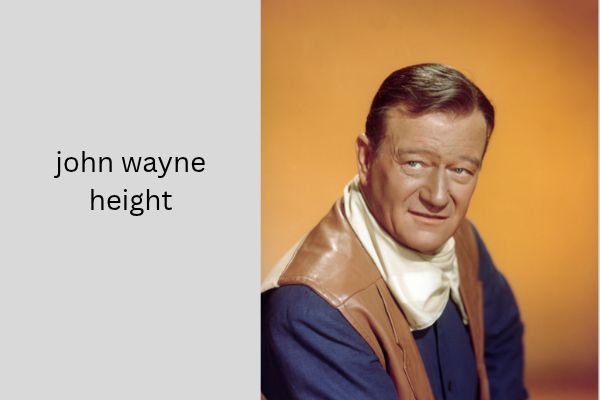
John Wayne Height:
John Wayne height is 6 feet 4 inches (193 cm).
The Hollywood legend towered over most leading men of his era, and his frame became inseparable from the image of the American Western hero. Some studio publicity materials rounded the figure slightly up or down, but 6 ft 4 in is the most commonly cited measurement and is consistent with what his co-stars and biographers described.
John Wayne Quick Facts
| Attribute | Detail |
|---|---|
| Full Name | Marion Robert Morrison (later Marion Mitchell Morrison) |
| Height | 6 ft 4 in (193 cm), approximate |
| Weight | About 225 lbs (102 kg) in his prime, approximate |
| Date of Birth | May 26, 1907 |
| Age | Died June 11, 1979, aged 72 (would be 119 today) |
| Birthplace | Winterset, Iowa, USA |
| Nationality | American |
| Zodiac Sign | Gemini |
| Profession | Actor, director, producer |
| Shoe Size | Approximately US 12 to 13 (unconfirmed) |
Early Life and Background

John Wayne was born Marion Robert Morrison on May 26, 1907, in Winterset, Iowa. His father, Clyde Morrison, was a pharmacist, and his mother, Mary “Molly” Brown Morrison, was a homemaker. When he was about four, the family moved to Palmdale, California, where Clyde tried homesteading in the Mojave Desert. The venture failed, and the family relocated to Glendale in 1916.
The boy picked up the nickname “Duke” from the family’s Airedale terrier, which he walked daily. Neighborhood firefighters began calling the boy “Little Duke,” and the name stuck for life.
At Glendale High School, Morrison was a standout. He played football, was president of the Latin Society, and earned a reputation as an active student. His football skills won him a scholarship to the University of Southern California, where he played under coach Howard Jones. A bodysurfing injury ended his football career, and he lost his scholarship-related standing on the team.
Needing work, he took a job at Fox Studios moving props, a position arranged through his connection with director John Ford and Western star Tom Mix, who had given the USC football players tickets in exchange for their help. That prop job opened the door to the film industry, and it set up one of the most famous careers in cinema history.
Career Journey and Timeline
1926 to 1929: Behind the scenes. Morrison worked as a prop man and extra, appearing in small, uncredited roles. John Ford became his early mentor and gave him bit parts.
1930: The Big Trail. Director Raoul Walsh cast the young actor in his first starring role in this epic Western, and he was billed as John Wayne. The film flopped commercially, and Wayne spent the next decade in B-movies and serials.
1939: Stagecoach. John Ford cast Wayne as the Ringo Kid, and the film made him a major star. It is widely regarded as a landmark Western.
1940s: Rise to stardom. Wayne starred in Fort Apache, Red River (1948), and Sands of Iwo Jima (1949), the last earning him his first Academy Award nomination for Best Actor.
1950s: Icon status. He starred in The Quiet Man (1952) and The Searchers (1956), the latter frequently listed among the greatest American films ever made. He also formed Batjac Productions.
1960: The Alamo. Wayne directed and starred as Davy Crockett in this ambitious epic.
1960s: Continued dominance. He appeared in The Man Who Shot Liberty Valance (1962), McLintock! (1963), and The Longest Day (1962).
1969: True Grit. Playing the one-eyed marshal Rooster Cogburn, Wayne won the Academy Award for Best Actor, the only Oscar of his acting career.
1970s: Final chapter. He starred in Rio Lobo, Big Jake, The Cowboys, and Rooster Cogburn, and finished with The Shootist in 1976, a fitting farewell to the genre he defined.
Wayne received the Congressional Gold Medal in 1979, shortly before his death from stomach cancer on June 11, 1979.
Physical Appearance in Detail
Everything about John Wayne’s physical presence was larger than life. At 6 ft 4 in, he stood roughly seven to ten inches taller than the average American man of his generation. Combined with broad shoulders and a heavy, powerful frame, he commanded the screen without needing to say a word.
In his prime, Wayne weighed around 225 pounds, though his weight varied across decades. Early photographs show a lean, athletic young man in the 1930s, while later films reveal a thicker, more imposing build.
He had brown hair, which he wore short and later covered with hairpieces in some productions. His eyes were blue-gray, often described as piercing in Technicolor, and he had a weathered, rugged face that suited the Western landscape.
His signature look included a Stetson hat, a neckerchief, leather vest, and gun belt. Equally famous was his distinctive walk: a rolling, deliberate stride that biographers have attributed to a combination of old injuries and natural athleticism. His slow, drawling manner of speaking completed a persona that countless actors have tried to imitate.
Costumers often tailored his wardrobe to emphasize his shoulders and height, while camera crews learned how to frame him against open skies and horizons to amplify his stature.
Height Comparison: How Wayne Stacks Up
Wayne was among the tallest leading men of Hollywood’s Golden Age. Most of his contemporaries stood between 5 ft 8 in and 6 ft 2 in, which made him stand out in ensemble casts. Directors often placed him at the center of a frame or slightly elevated him so that shorter co-stars did not look dwarfed, though in many scenes his natural height did the work for them.
Compared with other Western and action icons, Wayne ranked at or near the top. Actors such as Gary Cooper approached him in height, but few matched his combined height and bulk. Others, such as Alan Ladd, stood much shorter and famously required platforms or trenches for scenes with taller co-stars. The figures below are approximate and based on commonly cited measurements.
| Actor | Height (approx.) |
|---|---|
| John Wayne | 6 ft 4 in (193 cm) |
| Gary Cooper | 6 ft 3 in (191 cm) |
| Clint Eastwood | 6 ft 4 in (193 cm) |
| James Stewart | 6 ft 3 in (191 cm) |
| Henry Fonda | 6 ft 1 in (185 cm) |
| Alan Ladd | 5 ft 6 in (168 cm) |
How Height Shaped His Career and Public Image
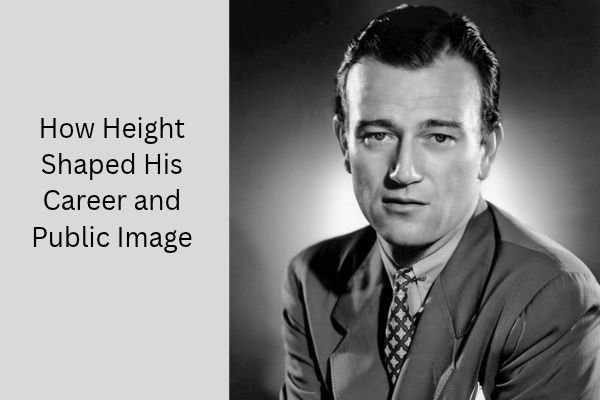
Wayne’s height was a defining asset, not a footnote. In the Western genre, where the lone hero dominates a vast landscape, a tall, broad-shouldered actor communicates authority instantly. Audiences read his size as strength, reliability, and moral certainty before he delivered a line.
His stature also influenced the way directors shot him. John Ford, who understood visual storytelling better than almost anyone, used low camera angles and wide compositions that emphasized Wayne’s silhouette against desert buttes and open sky. In The Searchers, Wayne’s looming figure in a doorway became one of the most iconic images in cinema.
Physical size shaped his casting too. He played cavalry officers, sheriffs, soldiers, ranchers, and lawmen, roles where a commanding presence was part of the job description. In war films such as Sands of Iwo Jima, his height reinforced his portrayal of a tough sergeant leading men into battle.
The effect carried beyond film. Wayne’s image merged with ideas of American masculinity, independence, and frontier spirit. Fans, politicians, and critics alike often described him as a symbol rather than just an actor, and his physical stature played a real part in that perception.
At the same time, his size made certain roles harder to cast around. Producers had to consider leading ladies and co-stars who could stand next to him without looking drastically mismatched, and some scenes required adjustments in staging. Even so, the benefits far outweighed the challenges, and his height remained central to his enduring screen legacy.
What Wayne Said About His Height
Wayne was not known for giving long interviews about his height, and he rarely drew attention to it directly. He approached his size with the casual attitude of a man who had never needed to think about it. Growing up, he was already tall for his age, and by the time he reached high school he was well over six feet, which helped him excel in football.
Colleagues and biographers have shared anecdotes about how he carried his height. Co-stars frequently remarked that he seemed even taller in person than on screen, and many described the experience of standing next to him as intimidating until his warm, humorous personality put them at ease.
Wayne often credited his athletic background, rather than his height alone, for shaping his physical confidence. He talked about the discipline of football and the lessons learned at USC as formative influences. He also spoke often about acting being a matter of presence and honesty rather than appearance, once suggesting that the key was simply to talk low, talk slow, and not say too much. That philosophy fits the minimalist style that made him famous.
There are no widely documented quotes in which Wayne addressed his exact height in feet and inches, so details come mostly from biographies, studio records, and accounts from colleagues.
Personal Life Brief
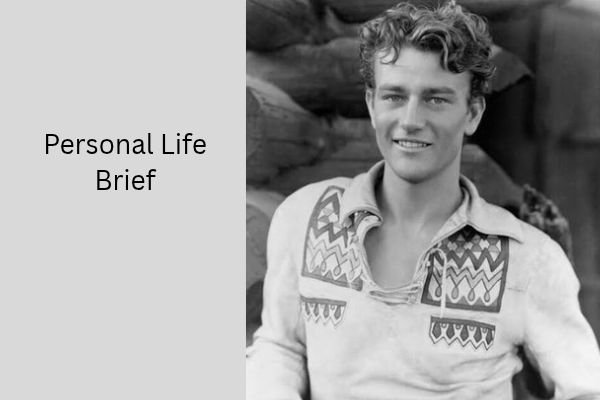
Wayne married three times. His first wife was Josephine “Josie” Saenz, whom he married in 1933 and with whom he had four children: Michael, Mary Antonia (Toni), Patrick, and Melinda. They divorced in 1945.
He then married Mexican actress Esperanza Baur in 1946, a union that ended in 1954. In 1954 he married Peruvian-born Pilar Pallete, with whom he had three children: Aissa, John Ethan, and Marisa. The couple separated in 1973 but never formally divorced.
Wayne was also a close friend of many Hollywood figures, including director John Ford and actor Ward Bond. He was known for his love of chess, fishing, and his yacht, the Wild Goose, a converted Navy minesweeper.
He was a vocal Republican and publicly supported conservative causes, which made him a controversial figure for some. In his final years, he battled lung cancer, which led to the removal of a lung in 1964, and later stomach cancer. He died in Los Angeles on June 11, 1979. His legacy continues through the John Wayne Cancer Institute and the John Wayne Airport in Orange County, California.
Frequently Asked Questions
Is John Wayne tall for a man?
Yes, very. At 6 ft 4 in, he was roughly 8 to 10 inches taller than the average American man of his era and still well above the average today.
What is John Wayne’s exact height in cm?
His height is approximately 193 cm. Some sources list slight variations, but 193 cm (6 ft 4 in) is the most commonly cited figure.
How does John Wayne’s height compare to Gary Cooper?
Cooper is usually listed at around 6 ft 3 in, so Wayne was about an inch taller, though the two are often grouped together as the tallest stars of classic Hollywood.
Has John Wayne talked about his height publicly?
Not extensively. He rarely addressed it directly, and most details come from biographers, co-stars, and studio records rather than Wayne’s own statements.
What is John Wayne’s shoe size?
His shoe size is not officially documented, but estimates based on his height and build suggest roughly US 12 to 13.
Is John Wayne taller than Clint Eastwood?
They are usually listed at the same height, around 6 ft 4 in, although some sources place Eastwood slightly shorter at 6 ft 3 in.
Does John Wayne’s height affect how he appears in his films?
Yes. Directors used his size to create commanding visuals, and his height gave him an automatic presence in group scenes, action sequences, and wide landscape shots.
What is John Wayne known for besides his height?
He is best known for his Western and war films, his Academy Award win for True Grit, his distinctive voice and walk, and his status as an American cultural icon.
How tall was John Wayne compared to his co-stars?
He towered over most of them. Actresses such as Maureen O’Hara, who was about 5 ft 8 in, were among the taller leading women who paired well with him on screen.
Did John Wayne’s height change with age?
Like most people, he likely lost a small amount of height in later life, though no precise later measurement is publicly documented.
