

Dana White Height: How Tall Is the UFC President?
Dana White height is 5 feet 8 inches (173 cm).
That is the figure most commonly cited across sports media and biographical profiles. It puts the UFC CEO very close to the average for an American man, which is a notable contrast with the towering heavyweights and light heavyweights he promotes. Some sources list him a fraction shorter or taller, so treat the number as a close approximation rather than a measured official statistic.
QUICK FACTS
| Attribute | Detail |
|---|---|
| Full Name | Dana Frederick White Jr. |
| Height | 5 ft 8 in (173 cm), approximate |
| Weight | About 185 lbs (84 kg), approximate |
| Date of Birth | July 28, 1969 |
| Age | 57 (as of September 2026) |
| Birthplace | Manchester, Connecticut, USA |
| Nationality | American |
| Zodiac Sign | Leo |
| Profession | CEO of the UFC, businessman, TKO Group executive |
| Shoe Size | Not publicly confirmed |
EARLY LIFE AND BACKGROUND
Dana White was born in Manchester, Connecticut, and spent his early childhood in the Northeast before his family relocated. His parents separated when he was young, and he was raised largely by his mother, June. He spent part of his youth in the Boston area, and he later moved to Las Vegas as a teenager, where he attended Bishop Gorman High School and graduated in 1987.
His teenage years were shaped by a restless, working-class energy. He was more interested in fighting sports than in a traditional academic path. He briefly attended the University of Massachusetts Boston, but he left without finishing, and he took on a string of blue-collar jobs, including work as a bellhop in Boston and a stint in the trucking industry. The jobs paid the bills, but boxing was his real interest.
That interest grew into a routine. In Boston he began training in boxing and boxing-based fitness, eventually working with a trainer and running classes of his own. That gym experience mattered later, because it gave him a working feel for how fighters trained, how they were managed, and how poorly the business side of combat sports often served them. In the early 1990s he returned to Las Vegas, which would become the center of his professional life.
Growing up as an average-height kid in a sport that prizes size, he was a participant and an observer rather than a natural-born athlete, and that perspective shaped how he later thought about fighters and fans alike.
CAREER JOURNEY AND TIMELINE
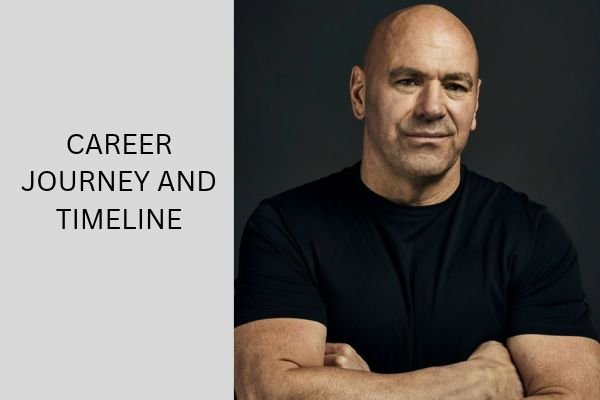
1990s: Boxing fitness and management. After returning to Las Vegas, White opened boxing and aerobics fitness classes and built a client list that included wealthy locals. He later moved into fighter management, and he took on two MMA fighters who would become stars: Tito Ortiz and Chuck Liddell.
2000: Meeting the Fertittas. Through his connections, White was introduced to brothers Frank and Lorenzo Fertitta, casino executives and former Nevada Athletic Commission members. The UFC was then struggling. It had been banned from cable television in many markets and carried a reputation as a brutal spectacle with few rules.
2001: Buying the UFC. In January 2001, the Fertittas purchased the promotion for a reported $2 million through a new company called Zuffa, and White became its president. He set about rebranding the sport, working with state athletic commissions to adopt the Unified Rules of Mixed Martial Arts and pushing for regulated, legitimate competition.
2005: The Ultimate Fighter. The reality series was a turning point. Its finale, in which Forrest Griffin and Stephan Bonnar fought a three-round war, is widely credited with pulling the UFC into the mainstream.
2006 to 2010: Growth and acquisitions. The company bought competitors including Pride Fighting Championships, WEC, and Strikeforce, consolidating much of the sport’s top talent.
2016: The sale. Zuffa was sold to a group led by WME-IMG for a reported $4 billion. White stayed on as president and continued to run the day-to-day business.
2023: TKO era. The UFC and WWE were merged under a new public company, TKO Group Holdings, with White holding a senior role while continuing to lead the UFC.
2022 onward: New ventures. White launched Power Slap, a slap-fighting league, and later moved into boxing promotion through partnerships aimed at reshaping that sport’s business model.
Across more than two decades, he has turned a niche, controversial sport into a global entertainment business.
PHYSICAL APPEARANCE IN DETAIL
At roughly 5 ft 8 in and around 185 pounds, White has a compact, solid frame that reads as athletic rather than tall. He has a barrel-chested build, and his years of boxing-style training and more recent focus on health and longevity have kept him looking fit into his fifties.
His most recognizable feature is his shaved head. He has been bald for years and pairs the look with a stubble-based facial style. His eyes are generally described as brown. His presence is defined less by size than by intensity, as he speaks quickly, gestures often, and carries himself with the impatience of someone who has always been in motion.
His signature style is understated and consistent: dark t-shirts, jeans or casual trousers, sneakers or boots, and frequently a cap or sunglasses. At events he typically wears a plain black shirt or a simple jacket rather than a suit, a choice that reinforces his image as a fight fan first and executive second. He has also been open in recent years about his health regimen, including changes to diet, exercise, and lifestyle habits.
In photographs, his measured height is easy to misjudge. Cameras often catch him next to enormous athletes, which can make him look smaller than he is. In everyday settings, he stands squarely within the normal adult male range.
HEIGHT COMPARISON

Context is the best way to understand Dana White height. Most professional fighters have a height that suits their weight class, so a fighter at heavyweight or light heavyweight is typically well over six feet, while flyweights and bantamweights are often shorter than White. He sits in the middle, roughly matching a welterweight or lightweight in stature.
Next to the sport’s biggest names, he is noticeably shorter, but among the broader public he is unremarkable, and next to media personalities from the combat sports world he is close to the average. The table below lists commonly cited heights for several relevant figures.
| Figure | Role | Approximate Height |
|---|---|---|
| Dana White | UFC CEO | 5 ft 8 in (173 cm) |
| Joe Rogan | UFC commentator, podcaster | 5 ft 7 in (170 cm) |
| Conor McGregor | Former two-division UFC champion | 5 ft 9 in (175 cm) |
| Chuck Liddell | UFC Hall of Famer | 6 ft 2 in (188 cm) |
| Jon Jones | Former UFC heavyweight champion | 6 ft 4 in (193 cm) |
| Vince McMahon | Former WWE chairman | 6 ft 2 in (188 cm) |
Heights for public figures vary between sources, so all figures above are approximate.
HOW HEIGHT SHAPED HIS CAREER AND PUBLIC IMAGE
In most industries, executives are scrutinized for the impression they make in a room, but combat sports is unusual because the athletes are physical specialists. In that environment, a promoter of average size has to command respect in other ways, and White has done exactly that.
His authority rests on his reputation for straight talk, his willingness to confront fighters and media, and his control of the sport’s most valuable platform. Being an average-sized man in a world of giants has arguably helped his image. Fans see him as one of them, a fan who made it, rather than a distant figure in a suit. His plain style, blunt language, and visible passion for fights make him relatable, and that authenticity has been central to how the UFC brand presents itself.
Height also appears in his business decisions in a practical way. Weight classes are a foundation of the sport, and part of the promoter’s job is understanding how size, reach, and speed interact. His background in boxing training gave him a working familiarity with that, and his years of watching fighters of every size shaped how he built divisions, matched fighters, and marketed stars from flyweight to heavyweight.
There is also a subtle visual effect. When White stands beside towering athletes at weigh-ins and press conferences, the contrast reinforces the scale of the people he promotes. He does not compete with their physical presence. He frames it.
None of this suggests his height determined his success. It simply meant he had to earn credibility through decisions, deals, and relationships rather than through physical presence, which is a lesson that applies well beyond sports promotion.
WHAT HE HAS SAID ABOUT HIS HEIGHT
There are no widely documented interviews in which Dana White discusses his height at length, and no verified quotes worth citing here. Unlike some celebrities who address the subject with jokes or defensiveness, he generally does not appear to treat it as a topic at all.
That absence is telling. His public conversations focus on fighters, business, health, media, and the future of the sport. When his size comes up, it is usually in the context of fan discussion or comparison photos rather than his own commentary. Fans and media occasionally note how small he looks next to heavyweight champions, and the observation tends to be good-natured.
Because no official measurement has been published, the 5 ft 8 in figure remains an estimate drawn from consistent reporting across profiles and databases. If White ever addresses the topic directly, that would be the most reliable update.
PERSONAL LIFE
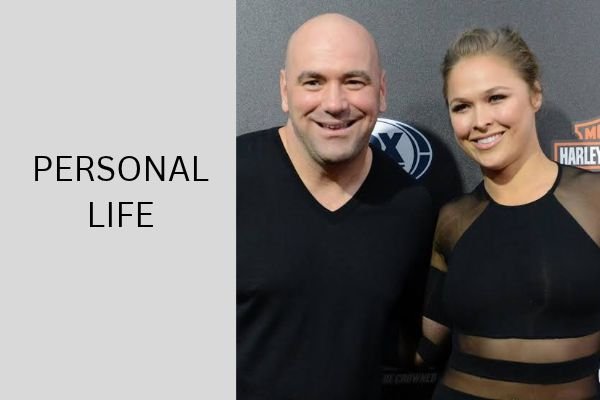
Dana White married Anne White in 1996. They met in Boston, and their relationship has lasted through the entire UFC story, from the early struggles to the billion-dollar valuation. The couple has three children: Dana III, Lorenzo, and Sierra. Lorenzo is named in honor of his business partner Lorenzo Fertitta, reflecting how closely intertwined the families have been.
The family is based in Las Vegas, where White has lived for most of his adult life. He has spoken about wanting to protect his family’s privacy, and he keeps most details of home life out of the spotlight, though he has occasionally shared moments on social media.
In recent years White has been more open about his health. He has spoken publicly about making major lifestyle changes after a medical wake-up call, including a focus on longevity, diet, and exercise. He remains extremely active professionally, running the UFC, overseeing event schedules, and managing outside ventures, while making time for his family.
FAQ
Is Dana White tall for a man?
No. At about 5 ft 8 in (173 cm), he is close to the average height for an American adult male, which is generally cited as around 5 ft 9 in.
What is Dana White’s exact height in cm?
Approximately 173 cm. Because no official measurement has been published, some sources list slightly different figures, but 173 cm is the most commonly cited.
How does Dana White’s height compare to Joe Rogan’s?
They are very close. Rogan is usually listed at about 5 ft 7 in (170 cm), which makes White roughly an inch taller by most accounts.
Has Dana White talked about his height publicly?
There are no well-documented interviews where he discusses it in detail. He tends to focus on business and fighting rather than his physical stats.
What is Dana White’s shoe size?
It is not publicly confirmed. Some fan sites list estimates, but there is no reliable source, so any number should be treated as a guess.
Is Dana White taller than Conor McGregor?
Not by most listings. McGregor is commonly cited at 5 ft 9 in (175 cm), about an inch taller than White.
Does Dana White’s height affect his work as a promoter?
Not in any meaningful way. His job depends on negotiation, matchmaking, and business strategy rather than physical size. His familiarity with weight classes and fighter builds is far more relevant than his own stature.
What is Dana White known for besides his height?
He is best known as the CEO of the UFC, the man who helped turn mixed martial arts from a fringe attraction into a global sports property. He is also known for creating The Ultimate Fighter, launching Power Slap, and holding a senior leadership role at TKO Group Holdings.
Is Dana White’s height listed the same everywhere?
Mostly, yes. The 5 ft 8 in figure appears in the majority of biographical sources, though a few list him at 5 ft 7 in or 5 ft 9 in. Small discrepancies like this are common for public figures without official measurements.
