
Bruce Lee Height: How Tall Was the Legendary Martial Artist?
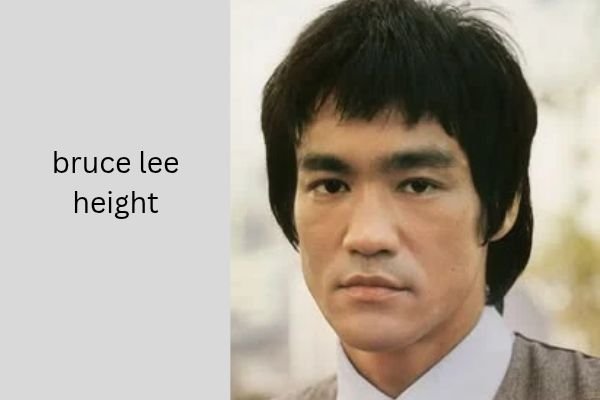
Bruce Lee height is 5 feet 7 inches (170 cm).
That figure is the most commonly cited measurement, though a few sources round it up to 5 feet 7.5 inches or 5 feet 8 inches. Lee stood close to average for a man born in 1940, yet his lean, sculpted physique and explosive speed made him look far larger on screen than the numbers suggest.
Quick Facts
| Attribute | Detail |
|---|---|
| Full Name | Lee Jun-fan (Bruce Lee) |
| Height | 5 ft 7 in (170 cm), approximate |
| Weight | About 135-141 lbs (61-64 kg) |
| Date of Birth | November 27, 1940 |
| Age | Died at 32 on July 20, 1973 (would be 85 today) |
| Birthplace | San Francisco, California, USA |
| Nationality | American (raised in Hong Kong) |
| Zodiac Sign | Sagittarius (Year of the Dragon in the Chinese zodiac) |
| Profession | Martial artist, actor, filmmaker, philosopher |
| Shoe Size | Not officially documented; unverified estimates suggest around US 7 |
Early Life and Background
Bruce Lee was born in San Francisco’s Chinese Hospital while his father, Cantonese opera star Lee Hoi-chuen, was touring the United States. The family returned to Hong Kong when Bruce was still an infant, and he grew up in a crowded Kowloon neighborhood.
His screen career started almost by accident. Through his father’s connections, he appeared in films as a baby and later became a busy child actor, with more than twenty credits before adulthood. Lee was energetic and mischievous as a boy, and street fights were common in his neighborhood. That led him to begin formal training in Wing Chun under the master Yip Man around age thirteen.
He also excelled at dance and won a Hong Kong cha-cha championship in 1958. Concerned about his temper and run-ins with local gangs, his parents sent him back to the United States in 1959 with little money. He first lived in San Francisco, then settled in Seattle, where he finished high school and enrolled at the University of Washington to study philosophy. Those studies shaped the ideas he later developed into his own martial philosophy.
Career Journey and Timeline
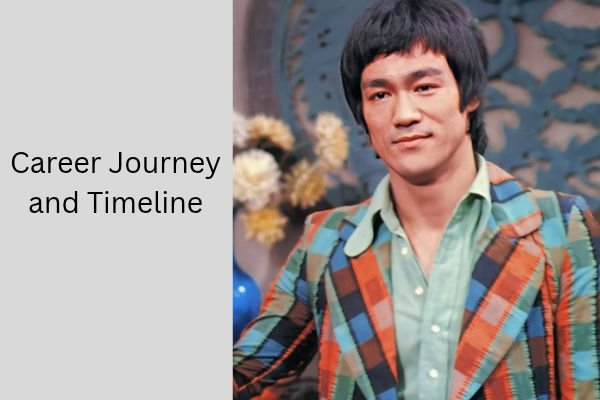
1940s-1950s: Child actor in Hong Kong. Lee’s first credits came as a child, and by his teens he had appeared in a string of local films, including The Kid in 1950.
1959-1964: Teaching in America. After returning to the United States, Lee began teaching martial arts in Seattle. He opened his first school, the Jun Fan Gung Fu Institute, and soon expanded to Oakland, California. He married Linda Emery in 1964.
1964: Long Beach and Hollywood. A demonstration at the Long Beach International Karate Championships caught the eye of television producer William Dozier.
1966-1967: The Green Hornet. Lee played Kato, the masked sidekick, and introduced American audiences to Chinese martial arts. The show lasted one season, but Lee became a sensation.
Late 1960s-early 1970s: Jeet Kune Do and small roles. Lee developed Jeet Kune Do, a philosophy built on adaptability and directness. He trained Hollywood stars, including James Coburn and Steve McQueen, and took guest parts in shows like Longstreet.
1971-1972: Superstardom in Asia. Unable to land a lead role in Hollywood, Lee returned to Hong Kong and signed with Golden Harvest. The Big Boss (1971) and Fist of Fury (1972) broke box-office records. He then wrote, directed, and starred in Way of the Dragon (1972), which featured the famous Colosseum fight with Chuck Norris.
1973: Enter the Dragon and death. Lee filmed Enter the Dragon, the first major Hollywood-Hong Kong co-production. He died on July 20, 1973, weeks before the film’s release. It became a worldwide hit and cemented his legend.
1978 and beyond. Game of Death was completed after his death using footage and doubles. His influence continues to shape action cinema, mixed martial arts, and popular culture.
Physical Appearance in Detail
At 5 feet 7 inches and roughly 135 to 141 pounds, Lee had a compact build. His body fat was famously low, and his physique was defined by lean, functional muscle rather than bulk. His forearms, shoulders, and abdominal muscles were especially prominent, and his back, often called his “cobra” flare when he spread his lats, became one of his signature poses.
Lee had jet-black hair, usually worn short on the sides with a longer, slightly tousled top, and dark brown eyes known for their intense focus on camera. His face was expressive, alternating between playful grins and steely stares.
His style was practical rather than flashy. On screen he favored simple black or white kung fu jackets and trousers, and off screen he often wore fitted shirts, slacks, and sunglasses in the fashion of the late 1960s. The yellow jumpsuit from Game of Death became one of the most recognized costumes in film history.
Lee trained obsessively. He combined weightlifting, isometrics, running, cycling, and martial arts drills, and he was among the first Western-era athletes to treat fitness as a science. This built the speed and power that let a man of average height dominate the screen.
Bruce Lee Height Compared to Other Martial Arts Stars
Lee was slightly shorter than many of his co-stars and rivals but close to the average for Chinese-born action performers of his era. In Way of the Dragon, the visual difference between him and the taller Chuck Norris became a central storytelling device, making Lee’s victory feel like a triumph of skill over size.
| Martial Artist | Height |
|---|---|
| Bruce Lee | 5 ft 7 in (170 cm) |
| Jackie Chan | 5 ft 7 in (173 cm) |
| Jet Li | 5 ft 6 in (168 cm) |
| Chuck Norris | 5 ft 10 in (178 cm) |
| Donnie Yen | 5 ft 10 in (178 cm) |
Heights for living celebrities are often self-reported or estimated and can vary by an inch between sources. Lee stood roughly level with Jackie Chan and Jet Li, and about three inches shorter than Norris and Yen.
How Height Shaped His Career and Public Image
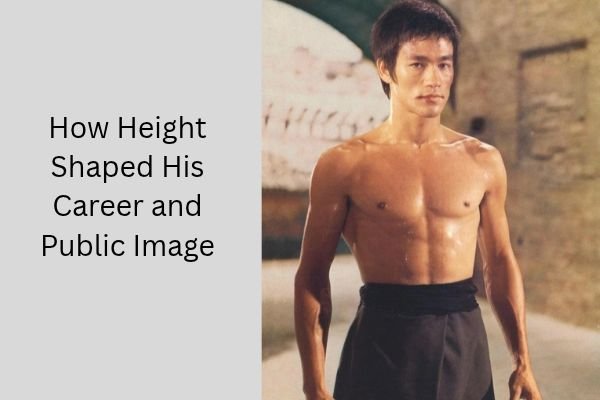
Lee’s height helped define his screen persona. Because he was not physically imposing, filmmakers often built stories around the idea that intelligence, discipline, and technique could beat brute strength. Audiences, especially in Asia, saw a hero they could relate to, not a giant.
It also influenced his fighting philosophy. Jeet Kune Do emphasizes economy of motion, speed, timing, and distance control. A smaller fighter cannot rely on reach, so Lee focused on closing gaps quickly, intercepting attacks, and striking from unexpected angles. Techniques like the one-inch punch became famous because they showed power generated through mechanics, not size.
In Hollywood, the same average height worked against him in some ways. In the 1960s and early 1970s, studios rarely cast Asian men as leading heroes, and his stature and ethnicity were used as excuses to pass over him. That frustration pushed him to Hong Kong, where he became the biggest star in the industry.
His most striking use of the size contrast came in Game of Death, where he faced Kareem Abdul-Jabbar, who is 7 feet 2 inches. The sequence turned the difference of more than a foot and a half into pure visual drama and remains one of the most memorable fight scenes in film.
Today, Lee’s height is often cited as proof that greatness is not tied to physical dimensions. Coaches, athletes, and fans still use him as an example of how skill and mindset can overcome disadvantage.
What He Said About His Height
There is no widely documented interview in which Bruce Lee spoke directly about how tall he was, and it is best not to attribute invented quotes to him. What is well documented is his broader philosophy about physical limits and adaptability.
Lee repeatedly stressed that a fighter should not depend on natural advantages. In writings and interviews, he described martial arts as a form of self-expression, and he encouraged students to work with the body they have rather than imitate someone else. His famous “be water” idea, delivered on a 1971 episode of Longstreet and later in interviews, captures that approach: adapt to the container, flow around obstacles, and stay formless.
Colleagues and students, including Dan Inosanto and Linda Lee Cadwell, have often described how Lee turned his size into a strategic advantage through speed, flexibility, and relentless practice. Those recollections consistently portray a man who thought about strategy, not stature.
Personal Life Brief
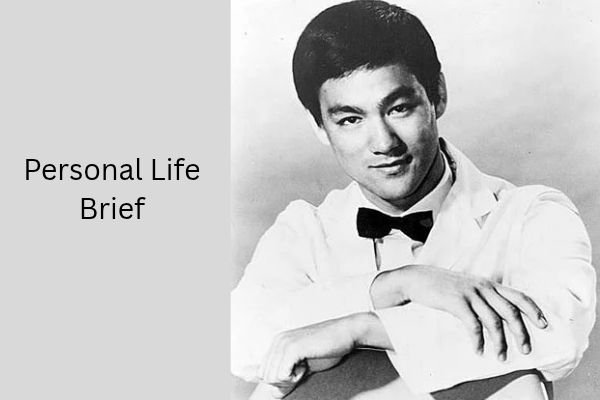
Lee met Linda Emery while teaching at the University of Washington, and they married on August 17, 1964. They had two children: Brandon, born in 1965, and Shannon, born in 1969. Brandon became an actor and died in 1993 during the filming of The Crow. Shannon is an actress and has led efforts to preserve her father’s legacy through the Bruce Lee Foundation and the Bruce Lee Family Company.
Lee’s death at 32 has been the subject of decades of speculation. The official finding was cerebral edema, a swelling of the brain, linked to a reaction to a pain medication. A 2022 medical review suggested it may have been caused by hyponatremia, or excessive water intake. Theories persist, but the documented cause remains a medical one.
Linda later remarried and remained the guardian of his archive. Lee’s estate, his memorabilia, and his books, including Tao of Jeet Kune Do, continue to attract global interest. He has been honored with a star on the Hollywood Walk of Fame, a statue in Hong Kong, and a growing list of documentaries and biopics.
Frequently Asked Questions
Was Bruce Lee tall for a man?
No. At 5 feet 7 inches (170 cm), he was close to average for men of his generation and slightly below the modern US average of about 5 feet 9 inches. His athletic build and screen presence made him appear larger.
What is Bruce Lee height in cm?
Bruce Lee height is about 170 cm, the most commonly cited measurement. Some sources give 172 cm, so treat the figure as approximate.
How does Bruce Lee’s height compare to Jackie Chan’s?
They were nearly identical. Lee was about 5 feet 7 inches (170 cm), while Jackie Chan is usually listed at 5 feet 7 inches (173 cm).
Did Bruce Lee ever talk about his height publicly?
There is no well-documented public statement from Lee specifically about his height. He did discuss adapting to one’s own body and abilities as a central principle of Jeet Kune Do.
What was Bruce Lee’s shoe size?
There is no verified, officially documented shoe size. Unconfirmed estimates place it around US 7, so it should be treated with caution.
Was Bruce Lee taller than Chuck Norris?
No. Chuck Norris is about 5 feet 10 inches (178 cm), roughly three inches taller than Lee, which is why their Colosseum fight in Way of the Dragon emphasized skill over size.
Did Bruce Lee’s height affect his fighting style?
Yes. Being average height meant he could not rely on reach, so he emphasized speed, timing, distance control, and efficient technique, all core elements of Jeet Kune Do.
How much did Bruce Lee weigh?
He typically weighed between 135 and 141 pounds (61 to 64 kg), with very low body fat, and he sometimes fluctuated slightly depending on training and film schedules.
What is Bruce Lee known for besides his height?
He is known for founding Jeet Kune Do, revolutionizing action cinema, popularizing martial arts worldwide, and inspiring modern mixed martial arts through his emphasis on cross-training and adaptability. Films like Enter the Dragon and Fist of Fury made him a global icon.
Was Bruce Lee shorter than Kareem Abdul-Jabbar?
Very much so. Kareem stands 7 feet 2 inches (218 cm), about 19 inches taller than Lee, a contrast used to dramatic effect in Game of Death.
