
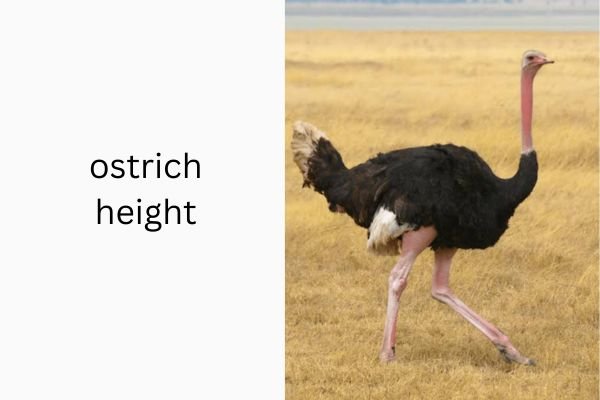
Ostrich height reaches up to 9 feet (2.7 meters) in adult males, making the ostrich the tallest living bird species on Earth. Females are somewhat shorter, typically standing 5.5 to 6.5 feet tall. This extreme height, combined with powerful legs and a long neck, is central to how ostriches survive, spot predators, and move across open grassland at speed.
Quick Facts Table
| Attribute | Detail |
|---|---|
| Species Name | Common Ostrich (Struthio camelus) |
| Height (Male) | 7.5–9 ft (2.3–2.75 m) |
| Height (Female) | 5.5–6.5 ft (1.7–2 m) |
| Weight | 220–350 lbs (100–160 kg) |
| Lifespan | 30–40 years in the wild |
| Native Habitat | African savannas, grasslands, and open woodland |
| Distribution | Sub-Saharan Africa (wild); farmed worldwide |
| Family | Struthionidae (flightless ratites) |
| Top Running Speed | Up to 45 mph (70 km/h) |
| Egg Size | Largest of any living bird, ~6 inches long |
Early Life & Growth
An ostrich chick hatches at around 10 inches tall and weighs roughly 2 pounds, but its growth rate is extraordinary. Chicks can grow nearly a foot per month during their first year, reaching almost full adult height by 12 to 18 months of age. This rapid growth is fueled by a high-protein diet of seeds, shrubs, insects, and small reptiles, and it allows young ostriches to keep pace with adult flock members almost immediately after hatching, which is critical for avoiding predators like lions, hyenas, and cheetahs on the open savanna.
Ostriches are precocial birds, meaning chicks are mobile and alert within hours of hatching. They’re raised communally, often in creches of dozens of chicks watched over by just one or two adult pairs, a strategy that improves survival odds while the birds are still building toward their full height and strength.
Growth Timeline: From Hatchling to Full Height
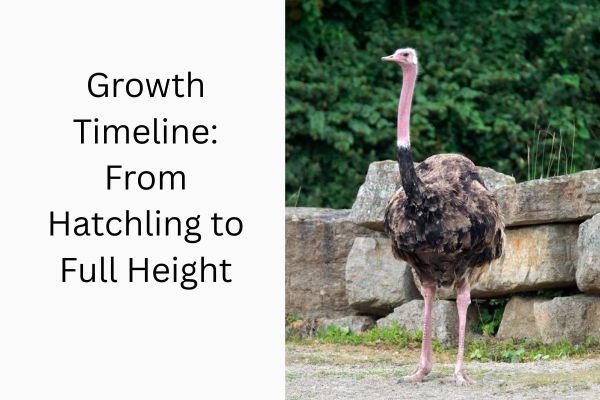
Hatching (Day 0): Chicks emerge at about 10 inches tall, already covered in downy feathers and able to walk within hours.
1–3 Months: Explosive growth begins. Chicks can gain up to 1 foot of height per month, aided by a diet rich in protein.
4–6 Months: Juveniles reach roughly half their adult height, around 3.5 to 4.5 feet, and begin developing the long neck and leg proportions of adults.
8–12 Months: Most of the skeletal growth is complete. Birds approach 6 to 7 feet, though they haven’t yet reached full muscular and reproductive maturity.
12–18 Months: Ostriches reach their full adult height — up to 9 feet in males and around 6.5 feet in females.
2–4 Years: Sexual maturity is reached (females mature slightly earlier, around 2 years; males around 3–4 years). Males develop their distinctive black-and-white plumage, replacing the brownish-gray juvenile feathers.
Adulthood (4+ Years): Full breeding condition is reached, height is locked in, and males begin territorial and courtship displays that make use of their imposing size.
Physical Build in Detail
Ostrich height comes almost entirely from two features: an extremely long neck and long, muscular legs. The neck alone can account for 3 to 4 feet of total height and is mostly bare-skinned, ranging in color from pale pink to blue-gray depending on subspecies and breeding condition. The legs, which make up roughly half the bird’s total height, are covered in thick scaled skin and end in a unique two-toed foot — the only bird with just two toes, an adaptation built for speed and powerful kicks.
Males are visually striking, with jet-black body plumage offset by white wing and tail feathers, while females and juveniles have duller grayish-brown feathers that provide better camouflage while nesting. Despite their height and bulk, ostriches cannot fly; their small wings are used for balance while running, courtship displays, and shading chicks rather than flight.
Height Comparison: Ostrich vs. Other Large Birds
Ostrich height dwarfs every other living bird species. Here’s how it stacks up against other notably tall birds:
| Species | Average Height |
|---|---|
| Common Ostrich (male) | 7.5–9 ft (2.3–2.75 m) |
| Emu | 5.5–6.2 ft (1.7–1.9 m) |
| Southern Cassowary | 4.9–5.9 ft (1.5–1.8 m) |
| Greater Rhea | 4.3–4.6 ft (1.3–1.4 m) |
| Sarus Crane (tallest flying bird) | 5.9–6.2 ft (1.8–1.9 m) |
| Great Blue Heron | 3.2–4.5 ft (1–1.4 m) |
No other bird comes close to ostrich height. The emu, its closest large-bird rival, tops out at roughly two-thirds of an adult male ostrich’s stature. Among flying birds, the sarus crane is the tallest, but even it falls well short of an ostrich standing at full height.
How Height Shapes the Ostrich’s Survival and Behavior
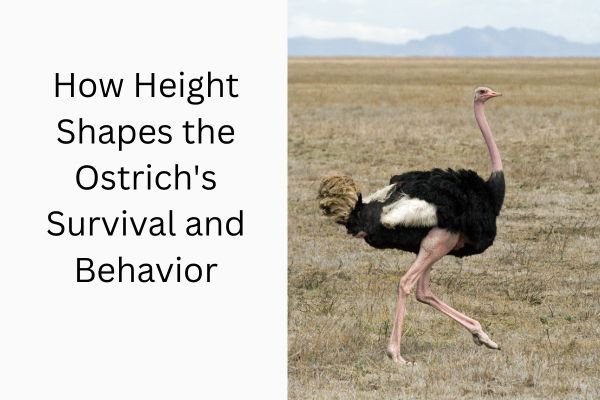
Ostrich height isn’t just a visual spectacle — it’s a survival tool refined by evolution. Standing up to 9 feet tall gives an ostrich an elevated vantage point over the grasslands of sub-Saharan Africa, allowing it to spot predators such as lions and hyenas from long distances, often before other grazing animals notice a threat. This is why zebras, wildebeest, and antelope are frequently seen grazing near ostriches — they benefit from the bird’s superior sightlines.
That height also translates into a formidable defense mechanism. An ostrich’s powerful legs, which are a major component of its overall stature, can deliver a kick strong enough to kill a lion, and its long legs enable running speeds of up to 45 mph, faster than any other bird on land. Rather than fleeing into cover like smaller animals, a full-grown ostrich often has the option to stand its ground or outrun nearly any predator on the savanna.
Height also plays a role in reproduction and social hierarchy. Taller, more physically imposing males tend to win territorial disputes and are more successful in courtship displays, which involve dramatic wing-flapping and neck movements that are only fully effective at an ostrich’s natural scale. In farmed and captive settings, height and overall body condition are also used by breeders as indicators of a bird’s health and genetic quality.
Ostrich Height in Captivity and Farming
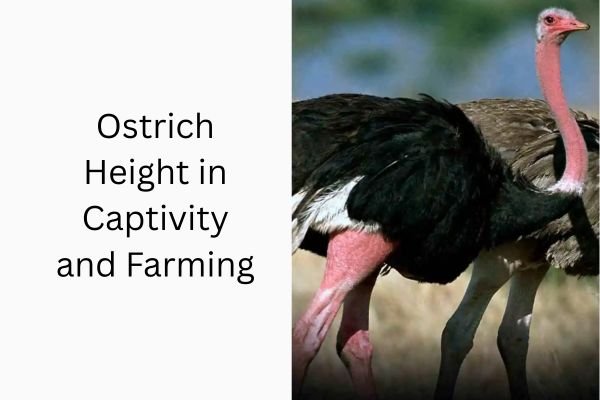
Farmed ostriches, raised commercially for meat, leather, and feathers, generally reach the same height range as their wild counterparts when given adequate space and diet, though farm-raised birds sometimes show slightly reduced growth if nutrition or space is limited during the critical first year. Ostrich farming operations, common in South Africa, the United States, and parts of Europe and Asia, often monitor chick growth rates closely, since a bird reaching expected height benchmarks on schedule is considered a strong indicator of overall flock health.
FAQ Section
Is an ostrich tall compared to other animals?
Yes. At up to 9 feet, an adult male ostrich is taller than most humans and taller than any other living bird species.
What is an ostrich’s exact height in cm?
Adult males typically measure 230 to 275 cm, while females measure roughly 170 to 200 cm.
How does ostrich height compare to an emu’s?
Ostriches are considerably taller. An adult male ostrich can reach 9 feet, while emus top out around 6.2 feet.
Do ostriches make sounds related to their size?
Yes. Male ostriches produce a deep, booming call during mating displays that’s often compared to a lion’s roar, a vocalization made possible partly by their long trachea.
What is an ostrich’s foot structure like?
Ostriches have just two toes per foot, unlike almost all other birds, which typically have three or four. This adaptation supports their height and high-speed running.
Are male ostriches always taller than females?
Yes, males are consistently taller and heavier than females, and they’re also distinguished by their black-and-white plumage compared to the females’ grayish-brown feathers.
Does ostrich height affect their running speed?
Yes. Their long legs, a major contributor to overall height, allow strides of up to 16 feet and top speeds of 45 mph.
Can ostrich height vary by subspecies or region?
Slightly. There are several recognized subspecies across Africa, and minor height and weight variations exist between them, though all are broadly within the ranges listed above.
What is an ostrich known for besides its height?
Ostriches are known for laying the largest eggs of any living bird, running at speeds rivaling some cars, and being completely flightless despite having wings.
How tall is a baby ostrich at hatching?
A newly hatched ostrich chick stands about 10 inches tall, reaching close to full adult height within 12 to 18 months.
